AI coding spend is out of control. Here is how to govern it.
Engineering approved the seat licenses. Finance signed the line item. Nobody set a token budget. Here is the governance layer that prevents the invoice from arriving as a surprise.
Engineering signed off on the seat licenses. Finance approved the line item. Nobody set a token budget.
Three months into full rollout, the invoice is 40% higher than the number that went through procurement. Claude Code's $100 per seat does not include the API tokens each engineer burns in a heavy sprint. GitHub Copilot's $19 per seat does not account for the Copilot Enterprise features that got enabled mid-quarter. Cursor was approved for 20 engineers; usage crept to 31 before anyone noticed.
This is the pattern. It repeats across nearly every AI coding rollout that skips a governance layer. Here is how to build one that actually holds.

Why are AI coding costs harder to predict than any other SaaS line item?
Most SaaS billing is seat-based. You buy 50 seats, you pay for 50 seats. Finance can model it in a spreadsheet without calling engineering.
AI coding tools break this model in two ways.
First, most platforms carry a dual cost structure: a fixed per-seat license and a variable token consumption layer. Claude Code charges per seat and per API token consumed. GitHub Copilot Business is seat-based, but Copilot Enterprise adds per-request costs for code review and documentation. Cursor's effective monthly cost varies by how intensively engineers use the AI-heavy features.
Second, token spend scales with adoption depth, not headcount. A team of 20 where four engineers are heavy users and 16 are occasional looks nothing like a team of 20 where all 20 are in Claude Code for six hours a day. The seat count is identical. The monthly token bill is not.
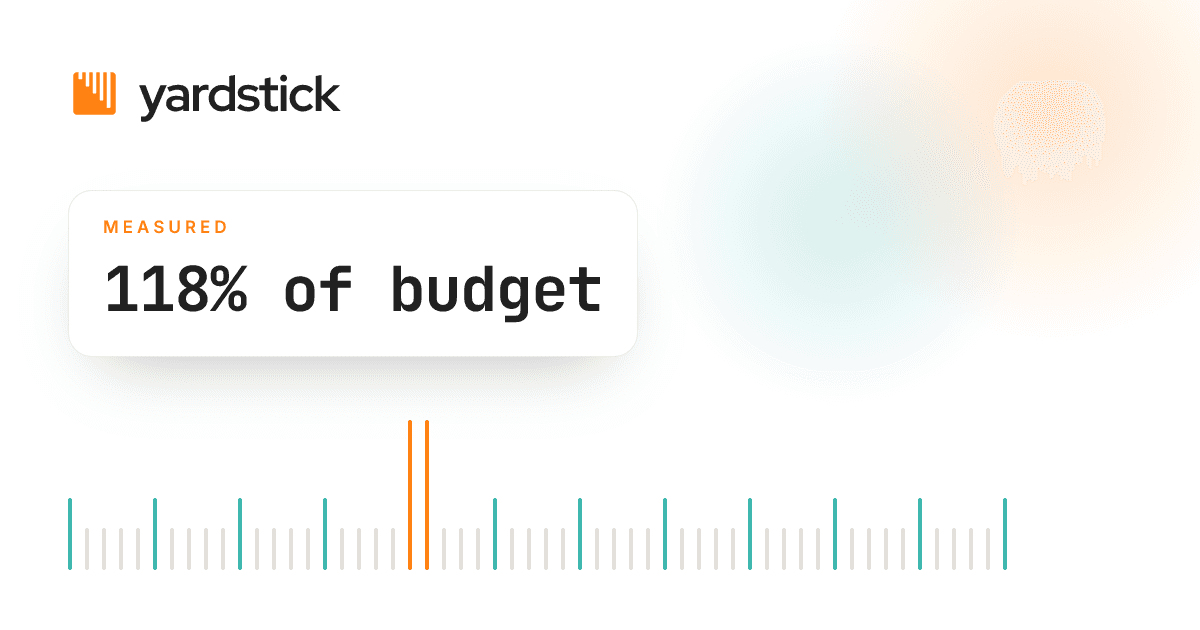
In Yardstick Treasury data, the median team running Claude Code at scale spends 118% of their projected AI coding budget in the first quarter after rollout. The gap is token costs that finance never approved because nobody thought to model them.
Pro Tip: Before any AI coding rollout, ask your vendor for 90 days of token consumption data from a comparable team. If they cannot provide per-engineer breakdowns, build a buffer of at least 40% above your seat license cost into the first quarter budget.
What are the cost layers most AI coding teams are not tracking?
Teams that run over budget almost always have clear visibility into one layer and no visibility into the other two.
AI coding cost stack
- Seat licenses · The number finance approved. Fixed, predictable, and usually the only number in the budget model. Does not reflect actual usage or actual cost.
- Token consumption · The variable layer. Scales with adoption depth, task complexity, and which product features engineers are using. Almost never carries a budget or an alert at rollout.
- Idle seat overhead · Licenses purchased for engineers who are not actively using the tool. In most rollouts, 20 to 35 percent of seats go underused after the first 60 days. The license cost continues regardless.
Governance means tracking all three. Tracking only seat licenses is roughly equivalent to budgeting cloud infrastructure by counting server instances without watching the CPU and memory bills.
How do you establish an AI coding cost baseline before you scale?
The baseline question is not what your vendor charges per seat. It is what a specific cohort of engineers actually spends, per merged PR, over a stable 60-day period.
To build a usable baseline:
- Select a representative cohort. Eight to 15 engineers across seniority levels and task types. Not the early adopters from the pilot. The median engineers on the team.
- Capture the full cost stack. Seat license prorated to the cohort, plus token consumption pulled from the vendor API or billing dashboard, divided by merged PRs over the period.
- Record the adoption depth. What percentage of commits in this cohort are meaningfully touching AI output? This number determines how much the token bill will scale when you expand.
- Set a per-engineer monthly ceiling. Total cost divided by cohort size gives you the per-engineer monthly figure. This becomes the budget benchmark for every engineer you add to the rollout.
- Document the idle rate. If three of 12 cohort engineers are using the tool fewer than five days per month, your idle rate is 25%. Apply that to headcount projections to avoid over-purchasing seats at scale.
Pro Tip: Run the baseline calculation before procurement signs a volume discount. Vendors offer better rates on larger seat counts, but a large seat count with a 30% idle rate is not a discount. It is an overpurchase.
How do you set a token budget that does not kill productivity?
The instinct when costs run high is to cap token usage. That instinct is correct, but the implementation usually goes wrong in one of two ways: the cap is set too low and engineers route around it, or the cap triggers a hard stop and a release gets delayed.
Token budgets work when they have three layers:
- A soft ceiling at 80% of the monthly allocation, where the system sends a notification to the engineering lead. No interruption to work. One data point for the team to act on.
- A hard ceiling at 100%, where new AI calls are queued rather than executed immediately. Engineers can still work; they lose the real-time completion speed. Urgent tasks can be escalated.
- An escalation path that lets a lead approve overage for a specific engineer or sprint without opening a procurement ticket.
The hard stop without an escalation path is what causes engineers to circumvent governance entirely. Give leads a one-click approval and the governance holds.
The token budget should be reviewed every 30 days for the first quarter after rollout and quarterly after that. Adoption depth changes. New product features change consumption patterns. A static budget set at month one will be wrong by month four.
What are kill switches and cost-aware routing, and when do you need them?
Kill switches and cost-aware routing are the two mechanisms that separate reactive AI cost management from proactive governance.
Kill switches are usage rules that pause AI activity under specific conditions: a budget ceiling being hit, an anomalous spike in token consumption from a single engineer, or an out-of-hours usage pattern that does not match your team's work schedule. Kill switches are not punitive. They are circuit breakers. The right response to a $4,000 token day from one engineer's account is a pause and a conversation, not a retroactive invoice.
Cost-aware routing sends AI requests to different models based on task complexity and cost. A request to autocomplete a function signature does not need a frontier model. A request to refactor a 3,000-line legacy module does. Cost-aware routing keeps high-value tasks on expensive models and routine tasks on cheaper, faster alternatives. In Yardstick Treasury benchmarks, teams running cost-aware routing reduce token spend by 28 to 40 percent without measurable impact on output quality for the tasks routed to lighter models.
Kill switches become necessary the moment more than 20 engineers share a billing account. Cost-aware routing becomes valuable at the point where token costs represent more than 30% of your total AI coding line item.

What does AI coding governance look like at 20 engineers versus 200?
The governance structure that works for a 20-person engineering team is not the same one that works at 200. Complexity scales with headcount.
| Governance layer | 20 engineers | 200 engineers |
|---|---|---|
| Budget visibility | Single dashboard, reviewed weekly | Per-team dashboards, monthly rollup to finance |
| Token ceiling | Team-level monthly cap | Per-engineer daily cap with lead escalation |
| Idle seat monitoring | Manual quarterly audit | Automated alert at 30 days of low usage |
| Kill switch | Engineering lead has admin access | Platform-level, separate from eng lead permissions |
| Cost-aware routing | Optional, manual | Required, automated by task type |
| CFO reporting | Quarterly one-pager | Monthly report, formatted for finance |
| Vendor negotiation | Annual review | Quarterly consumption review with account rep |
The transition point where governance becomes structurally necessary is somewhere between 40 and 60 engineers. Below that, an attentive engineering lead can catch anomalies manually. Above it, anomalies compound faster than manual review can handle.
Pro Tip: If your organization is between 20 and 60 engineers, implement the 200-engineer governance structure now. Building it under pressure when you are already at 150 engineers is significantly harder than building it when you have 40.
What does a CFO-ready AI coding cost report look like?
The CFO conversation at renewal is not about what the tool can do. It is about what the tool cost and what it returned.
A CFO-ready report has four components:
- Total cost of ownership. Seat licenses plus token consumption plus any integration or support costs. Not just the line item finance approved. The full number.
- Cost per merged PR. Calculated from a six-week baseline before deployment and the current 90-day rolling average. The delta is the efficiency number. The measurement framework post covers how to calculate this correctly.
- Adoption depth by team. Which teams are using it heavily, which are underusing it, and what the idle seat rate is. Finance can see immediately where the per-seat cost is being earned and where it is not.
- Cost trajectory. Month-by-month token consumption for the last quarter. Is the spend stabilizing, growing, or declining? A stabilizing spend line with improving throughput is the best story you can tell at renewal.
The teams that handle renewal well are the ones who walk into that conversation with a single page showing all four components. No vendor slides. No analyst quotes. Their own numbers.
Key takeaways
- AI coding costs have two layers that almost never get modeled together at procurement: seat licenses (fixed) and token consumption (variable). The gap between them is where budget overruns originate.
- 118% of projected budget is the median first-quarter overage for teams running Claude Code at scale in Yardstick Treasury data. The fix is a token budget established before rollout, not after the invoice arrives.
- Idle seat overhead is the hidden cost most engineering leads miss. If 25 to 35% of seats go underused after the first 60 days, the per-active-user cost is significantly higher than the per-seat number finance approved.
- Kill switches and cost-aware routing are the two mechanisms that make AI coding spend manageable at scale. Kill switches catch anomalies. Routing keeps routine tasks off expensive models and reduces token spend by 28 to 40 percent.
- CFO-ready reporting requires total cost of ownership, cost per merged PR versus baseline, adoption depth by team, and a spend trajectory. Teams that prepare this before renewal avoid the conversation that ends with a cap on tool headcount.
Why most AI coding budget conversations happen too late
The pattern I see most often is this: engineering gets the tool approved based on seat license cost, runs the pilot without a token budget, sees the pilot numbers look good, gets the rollout approved, and then fields the first full-scale invoice four months later when token consumption has scaled and finance has no model for what they are looking at.
The CFO does not have a problem with AI coding spend. They have a problem with surprises. An invoice that is 40% higher than the approved line item, with no prior communication about variable token costs, reads as a governance failure. Not a technology failure. A governance failure.
The teams that avoid this start the cost conversation before the tool is approved, not after. They model the variable layer. They set a token ceiling before rollout. They bring finance a projected range, not a fixed number, and they explain what drives that range. When the real invoice arrives, it is within the projected range, and the conversation is about whether the efficiency gains justify the cost, not about why nobody told finance the seat license was not the full cost.
This is not a complicated process. It requires one additional conversation during procurement and one additional column in the budget model. The teams that do it spend less time explaining invoices and more time showing throughput results.
· Vukasin
How Yardstick Treasury tracks AI coding spend
Yardstick Treasury is the cost governance layer for AI coding teams. It connects to your AI coding tool billing APIs and your GitHub or GitLab PR data, and displays cost per merged PR, token consumption per engineer, adoption depth, and idle seat rate on a single dashboard updated daily.
For teams approaching a rollout or renewal, Treasury generates a spend projection based on your current adoption depth and task mix, so you can tell finance what the full-cost range looks like before the invoice, not after.
For teams already in production, Treasury runs automated alerts on consumption anomalies, applies cost-aware routing rules across tool tiers, and generates the four-component CFO report on a monthly cadence so the renewal conversation has a document behind it.
To see the platform or join the early access list, visit yardstick.fi/platform or review pricing for current plan options.
FAQ
What is the difference between seat license cost and total AI coding cost?
Seat license cost is the fixed per-engineer fee your vendor charges for access to the tool. Total AI coding cost includes seat licenses plus token consumption, which is the variable layer that scales with how heavily engineers use the tool. For most teams running Claude Code or Copilot Enterprise at production depth, token costs add 30 to 60 percent on top of the seat license line item.
How do you set a token budget for an AI coding tool rollout?
Start with a 60-day baseline from a representative cohort: total token spend divided by cohort size gives a per-engineer monthly benchmark. Apply a 40% buffer to account for sprint-to-sprint variation and new feature adoption. Set a soft alert at 80% of the monthly allocation and a hard ceiling at 100% with a lead-approval escalation path. Review the budget every 30 days for the first quarter.
When do kill switches become necessary for AI coding spend?
Kill switches become necessary once more than 20 engineers share a billing account, because manual monitoring at that scale cannot catch consumption anomalies before they hit the invoice. A kill switch is not a cap on productivity. It is a circuit breaker that triggers a notification and a brief pause when consumption exceeds a defined threshold, giving leads the information they need before costs compound.
What is cost-aware routing and how much does it save?
Cost-aware routing sends AI requests to different models based on task complexity. Routine tasks like autocompletion go to lighter, cheaper models. Complex tasks like multi-file refactoring go to frontier models where the quality difference is meaningful. In Yardstick Treasury benchmarks, teams running cost-aware routing reduce token spend by 28 to 40 percent without measurable impact on output quality for the tasks routed to lighter models.
What should a CFO-ready AI coding cost report include?
Four components: total cost of ownership including seat licenses and token consumption, cost per merged PR compared to the pre-deployment baseline, adoption depth by team showing the idle seat rate, and a month-by-month spend trajectory for the last quarter. A report with these four components answers the renewal question without requiring follow-up questions from finance.
Recommended

Leads commercial and go-to-market. Founder of Emberwood, an AI-driven cold-email agency for B2B, with a background in outbound, lead generation, and sales.